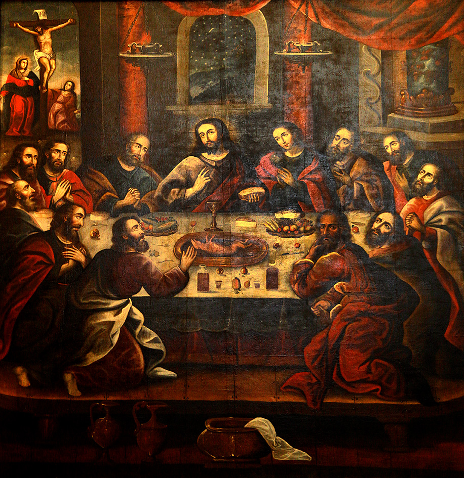
If you were raised even modestly Christian, or know a little about art history, you probably recognize this image as a depiction of the Last Supper. However, if you look closely, you notice something unexpected – amidst the familiar wine and bread, in the center of the table, is a guinea pig!
This painting hangs in the Cathedral Basilica of the Assumption in Cusco, Peru. The Cathedral was completed in 1654, but it took over one hundred years to fill the massive walls with the hundreds of paintings and sculptures required. This particular piece was completed in 1753 by Marcos Zapata, a Peruvian artist and member of the ‘Cusco School’ – a group committed to teaching European art techniques and themes to local artists.
That Zapata included this local delicacy in his depiction is not a huge surprise. Roasted guinea pig (‘Cuy’ in indigenous Quechua language) is still a common dish in the Andes. In fact, for many years, roasting a guinea pig was reserved for special occasions, or at least big family dinners at grandma’s house. So, while it looks unusual to us (or even disgusting, if you grew up with these furry pets) from that perspective, the mammal’s presence makes sense.
What requires a bit more thought is why the Spanish Catholic authorities hung the painting without demanding it to be altered, and have allowed it to stay in the holy place for 270 years! They certainly could have coerced Zapata to change his design – these are, after all, the same church authorities that brought us the Spanish Inquisition – but they didn’t. I think the reason they left the painting alone conveys some important lessons about change management.
The big lesson seems to be that change management doesn’t stand a chance if you can’t make it relevant to those you want to change – Including a celebrated local dish helped communicate the meaning and importance of the imagery to the largely illiterate remnants of the Incas whom the Spanish were trying to convert. In addition to this eternal truth the painting also suggests several less obvious best practices of successful change management:
- Focus on the ‘Why?’ of the change – Focusing the imagery of the Last Supper on the symbolic invitation to participate in Jesus’s saving grace provided the compelling “why” for the locals to convert to Catholicism. This message was much more important than the meal actually served. We have argued previously that the evidence is overwhelming, people are more motivated if they understand the purpose for what they are doing beyond just making more money for the boss.
- Don’t let perfection be the enemy of progress – Letting the locals think that Jesus and his disciplines dined on guinea pig is not technically correct (it is a new world mammal and would have been unknown in first century CE Jerusalem), but almost irrelevant relative to the larger message. Trying to process map every detail and demanding 100 precent adherence to mandated changes is tempting, but can miss the bigger picture.
- Involve those impacted with the ‘How?’ of the changes – Including those steeped in the local traditions in helping to convey the message and adapt the tactics to their reality was a wise a strategic choice on the part of the Church. In general, including those impacted by change in designing, communicating and implementing change programs can dramatically accelerate buy-in and thereby improve the likelihood of success.
- Balance positive and negative incentives to change – During the time of the Inquisition, hundreds of thousands across Europe showed up for Catholic services and mouthed the litany, but continued to practice their ‘heretical’ religious rituals in secret. Change experts call this phenomenon ‘tacit compliance’ – It is as if people are saying, “I will do the minimum to keep you off my back, but not change my beliefs, hoping that the next leadership team (or Pope?) will bring a different set of priorities.”
- While it is necessary to have a plan for those who do not adjust to the changes, one needs a balanced approach. The Cusco Last Supper may be an example of a more positive, and potentially more productive approach, to change the hearts and minds of those they were trying to convert.
- Even with a positive message, some people still won’t make it – as one of our clients says directly “I give people my expectations, I align their incentives with meeting those objectives and I give them the tools and training to get it done. At some point, if they cannot adjust, we are both better off if they seek employment elsewhere.” While it doesn’t need to be as harsh as eternal damnation or the tactics of The Spanish Inqusition, without consequences for those who resist, an entire change effort can be lost, as the rest of the organization learns to view change as optional.
- Lastly, a picture really is worth a thousand words – Using The Last Supper, as well as other compelling visual images, has been a key part of communicating the core stories and concepts that comprise the Catholic Faith. In a completely different context, those of us who have been consultants for a long time know the satisfying feeling that comes with nailing the ‘killer chart’ – a usually simple image that communicates the case for and/or intent of a change. We remember one client where we developed a Venn diagram that summarized the major decision rights for various parts of their organization. They liked it so much that the image became the cover page of their employee handbook. The image simplified and clarified the message for the target audience (unfortunately, over time some employees took to calling it the Mickey Mouse book because of the image’s resemblance to Disney’s iconic logo, but that may be the price of fame).
Conclusion
While we can’t be certain of the reasoning behind the church’s decision to hang this painting without alteration (and make other local adaptations to Catholic tradition and imagery) – we can be confident that it worked. Today, 35 percent of Peruvians report attending church at least once a week, while that number is below 20 percent for most of Europe and below 5 percent in Nordic countries and the UK.
Change management is frequently discussed and rarely done well. Perhaps these centuries-old lessons can help you think differently about the challenges of changing your organization – what could happen if you could really reach hearts and minds with the ‘why?’ and achieve broad engagement? Can you see how these might concepts might apply to some of the challenges that you currently face?
Special thanks to longtime friend Ron Bruggeman who unintentionally suggested this blog topic.
Leave a Reply